About this case study. The customer’s name is withheld by agreement — the deployment is real and running today. Every number below comes straight from Aelo’s production ledger (the same billing-grade records we invoice from), not from a survey or an estimate. We publish no customer quotes until the customer signs them off.
The company
A wholesale distributor of agricultural machinery and spare parts. Two call-heavy desks: sales (new equipment, trade-ins, seasonal campaigns) and parts & service (orders, availability, delivery status). The team lives in Bitrix24 — deals, calls, and tasks all happen there.
Call volume is the defining constraint: tens of thousands of conversations a month. No management team can listen to that. Before Aelo, nobody did — beyond occasional spot-checks.
Before: spot-checks and gut feel
The QA method was the one most sales teams still use:
- A manager opens a few recordings a week — usually after something already went wrong.
- Coaching is based on the handful of calls the manager happened to hear.
- Disputes (“the client was told X”) get settled by memory, or by digging through recordings for an hour.
- What the other 95%+ of conversations contained — nobody knew.
Manual listening covered a small fraction of the stream, selected mostly by accident. Not because the team didn’t care — because the volume made anything else physically impossible.
The rollout
- Aelo connected to Bitrix24 — the native app, installed against the company’s own portal. Calls flow in automatically; verdicts come back to the same CRM cards the team already works in.
- A scoring profile in the company’s own language — greeting, needs discovery, product knowledge, objection handling, next-step agreement and more: 25 parameters across 8 groups, tuned to how a distributor actually sells, not a generic call-center template.
- Findings are auditable — a finding points to the transcript quote it rests on, where the call has one. A manager can open it and check it against the recording.
- Managers changed nothing in how they dial. Aelo runs in the background.
Numbers from the production ledger
Figures below are read directly from Aelo’s production database and billing ledger for this customer (launch — March 2026; snapshot — November 5, 2026):
| Metric | Value |
|---|---|
| Calls processed since launch | 178,000+ |
| Steady-state volume | 20,000+ calls / month (Jul: ~25k, Aug: ~24k, Sep: ~24k, Oct: ~22k) |
| Calls scored end-to-end on 25 parameters | 44,000+ |
| Coverage of the scored stream | 100% — scoring runs on the stream, not on a sample |
| Time from call end to verdict in the CRM card | minutes, automatic |
Processed and scored are two different numbers: every call that reaches Aelo is ingested (the 178,000+), while the full scorecard runs only on calls that actually carry a conversation — missed calls are logged without a transcript and calls below the project’s minimum length (30 seconds by default) are not scored (the 44,000+), and within that scored stream nothing is sampled.
Both counts are floors. Call records leave the operational database when the customer’s retention window expires — the March 2026 rows and most of April’s are already gone — so the totals above add what the database holds today to the billing-ledger rows that outlived those records. The true historical figures are higher, never lower.
The honest caveat we’d want to see in anyone else’s case study: this data confirms scale, coverage, and cost — it can’t by itself prove revenue causality (“Aelo added X% to sales”). We don’t claim what we can’t measure.
What changed for the team
Coverage stopped being a sample. “Which calls did we check this week?” is no longer a question — the stream is scored continuously, on identical criteria for every rep.
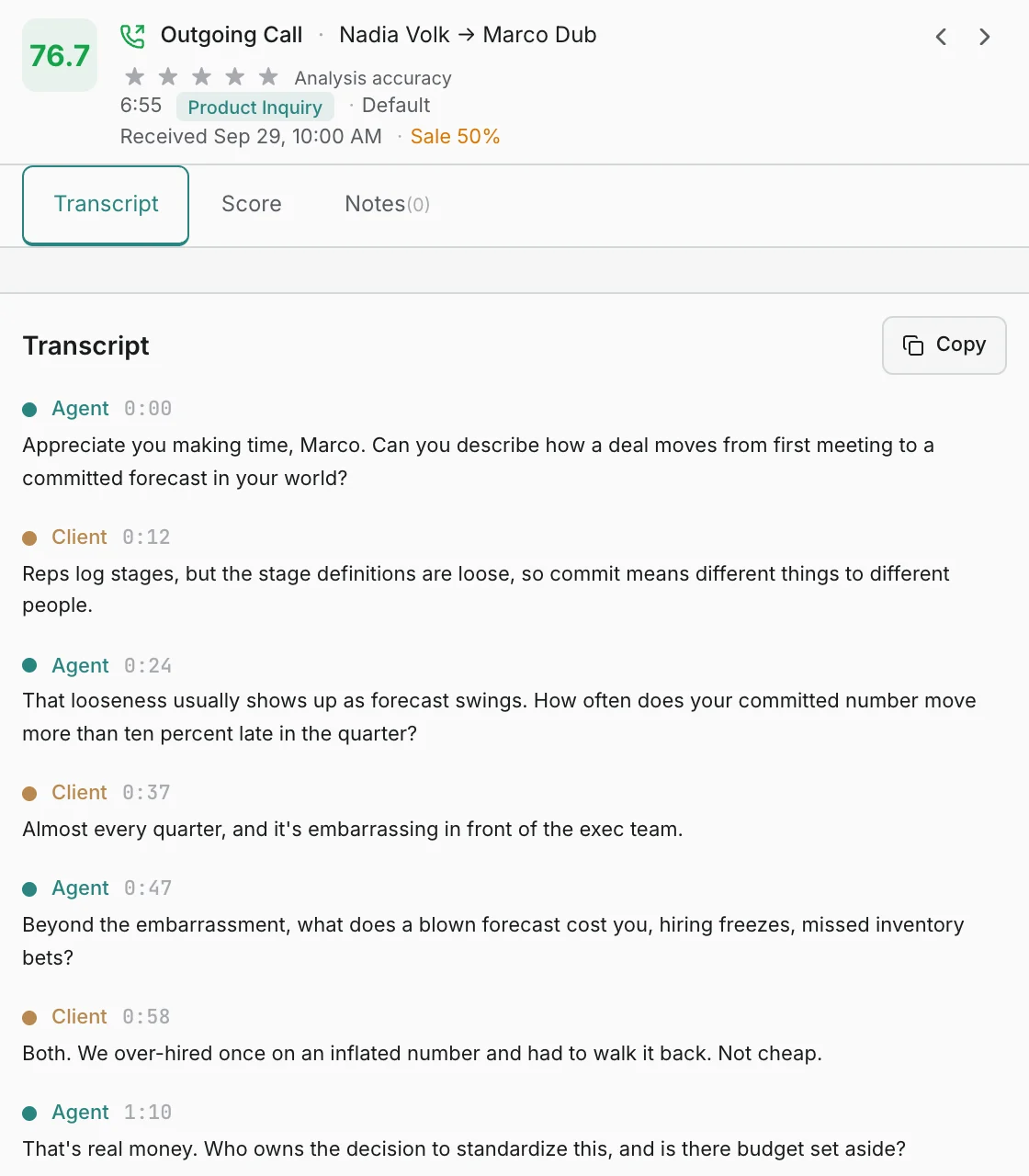
Coaching switched from anecdotes to patterns. Instead of “I listened to two of your calls,” managers see where each rep systematically loses points — and coach on that, with a transcript quote as evidence where the call has one.
Disputes resolve in seconds. “What exactly was the client told?” is answered by opening the call card: transcript, score, and the quote behind a finding where the call has one — not by an hour of re-listening.
The economics stayed boring — by design. Aelo charges per analyzed minute, and this deployment runs at wholesale-scale volume on a predictable monthly budget, with a limit that alerts you in the product. Cost per call is a known number, visible in the ledger, every day.
Why this matters if you run a call-heavy team
This deployment is the core Aelo claim, tested at scale: if your sales live on calls, quality control can be a property of the system, not a heroic effort of one manager. A team doing 200 calls a month and a team doing 20,000 get the same thing — every call scored, findings backed by quotes where the call has them.
- See how scoring works: Product
- What it costs at your volume: Pricing — starts free, 100 minutes a month, no card
- Already on Bitrix24? Aelo vs built-in Bitrix24 AI
Frequently asked questions
How many calls does the distributor process with Aelo?
More than 178,000 calls since the March 2026 launch (snapshot of November 5, 2026), with a steady 20,000+ calls a month and 44,000+ scored end-to-end on 25 parameters. The processed and scored totals are floors: call records leave the operational database when the customer's retention window expires, so the true historical figures are higher, never lower.
Why are 178,000+ calls processed but only 44,000+ scored?
Every call that reaches Aelo is ingested, but the full scorecard runs only on calls that actually carry a conversation. Missed calls are logged without a transcript, and calls below the project's minimum length (30 seconds by default) are not scored. Within the scored stream nothing is sampled: coverage is 100%.
What does the scorecard check, and can a manager verify a finding?
The scoring profile has 25 parameters in 8 groups; among what it checks are greeting, needs discovery, product knowledge, objection handling and next-step agreement. All of it is tuned to how a distributor sells. A finding points to the transcript quote it rests on, where the call has one, so a manager can open it and check it against the recording.
Do managers have to change how they work in Bitrix24?
No. Aelo is connected as the native Bitrix24 app, installed against the company's own portal. Calls flow in automatically, verdicts come back to the same CRM cards the team already works in within minutes, and managers changed nothing in how they dial. Aelo runs in the background.
Does the case prove that Aelo increased sales?
No, and the case says so. The data confirms scale, coverage and cost, but it cannot by itself prove revenue causality. Aelo charges per analyzed minute; this deployment runs on a predictable monthly budget with a limit that alerts you in the product, and the cost per call is visible in the ledger every day.