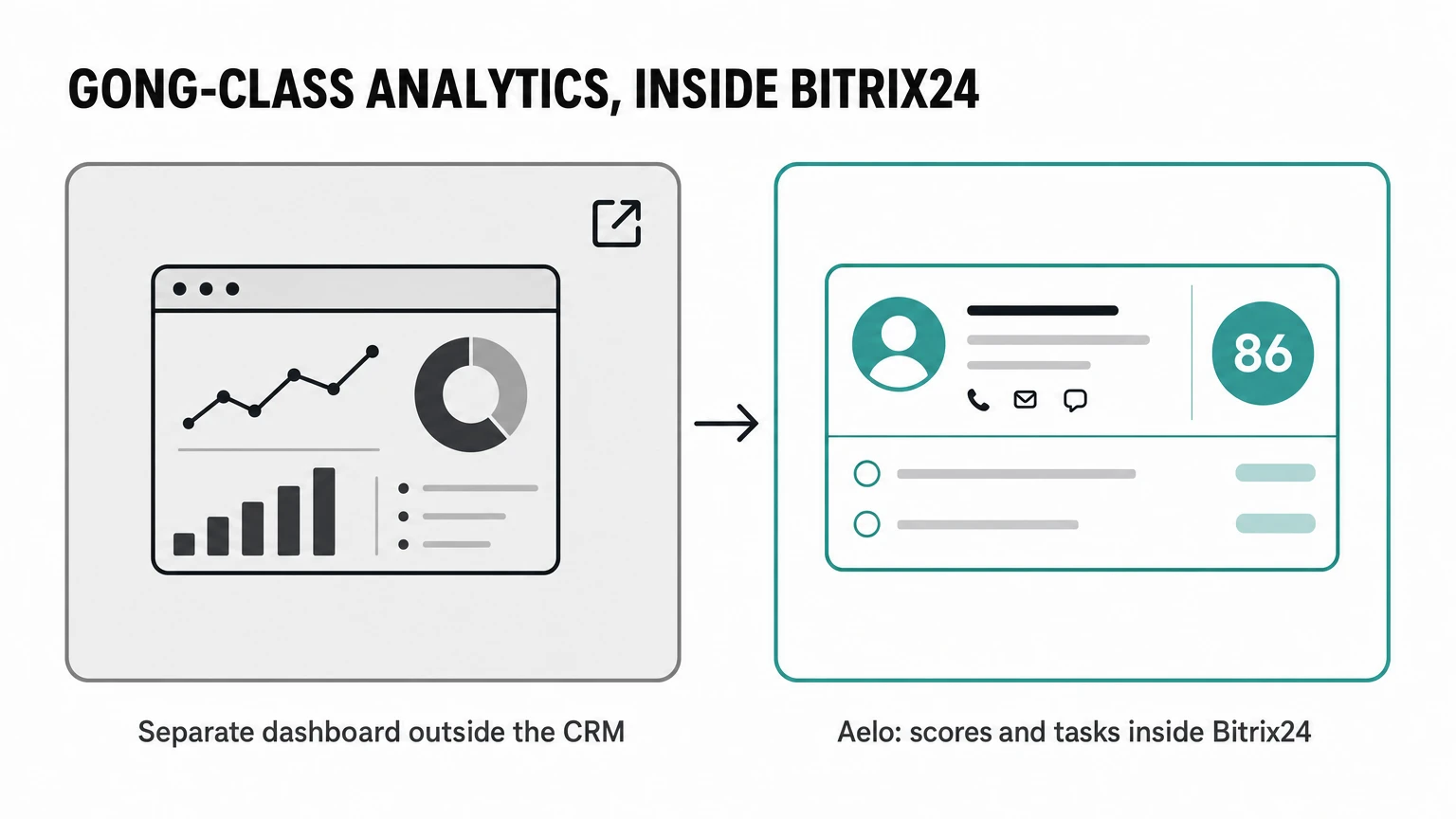
The short version. “Conversation intelligence” — the category Gong made famous — turns every sales call into structured, searchable data instead of an archived recording. It genuinely works. But the tools that defined it are built for enterprise teams on Salesforce and Zoom, hosted in the US, and priced per seat. If your team runs on Bitrix24 and telephony, most of that doesn’t fit you. This is what the Gong class actually gives you, when you need the real Gong, and how Aelo delivers the same class of analysis natively inside Bitrix24.
What “conversation intelligence” actually means
Every sales team already records calls. But a folder of recordings is an archive — write-only memory. You can replay one when a dispute comes up, but you can’t ask a shelf of audio a question. “Where are we losing this quarter’s deals?” has no answer that lives in the recordings; it lives in someone’s head, if anywhere.
Conversation intelligence — also called revenue intelligence — is the shift from recording to reading. Every call is transcribed, structured, and scored automatically, which turns a pile of audio into something you can query, compare, and act on. Once that happens, four things become visible that a CRM alone never shows:
- What reps actually said. The CRM holds the rep’s summary from memory — “client interested, will follow up.” The call holds the discount that got promised, the objection that went unanswered, the competitor that got named. Those two versions rarely match.
- Quality on one scale, across everyone. Instead of a manager’s gut feel about the 5–10% of calls they had time to hear, every call is scored on the same scorecard — one fixed list of criteria, applied to everyone. A “7” from one rep means the same thing as a “7” from another — comparable across the team and across weeks.
- Patterns across the whole base. Because every call is structured, you can ask questions of the entire stream: where in the funnel deals stall, which objection is losing this quarter, which rep systematically skips discovery. You cannot see a pattern in a 5% sample — that is a property of coverage.
- Commitments that don’t evaporate. “I’ll send the proposal Tuesday” is captured on the spot and can become a task automatically.
Gong built the category and proved it works at enterprise scale. So the question for most teams isn’t whether this class of tool is useful — it is — but whether the enterprise products that pioneered it fit the way their own team works.
Why Gong, Chorus, and Avoma don’t fit a Bitrix24 team
These are strong products for the teams they were built for. That’s exactly the catch: they were built for a specific stack, and it isn’t yours if you run on Bitrix24.
- No native Bitrix24 integration. The category leaders center on Salesforce, HubSpot, and Microsoft Dynamics. Bitrix24 isn’t a first-class CRM for them, so the verdict doesn’t land on the deal card your managers actually work in — at best it lives in a separate tool they have to remember to open.
- Meeting-first by design. Gong, Chorus, and Avoma grew up around online meetings — a bot joining your Zoom or Teams calls. If your sales happen on the phone — Binotel, Ringostat, SIP, Bitrix24 telephony — that’s a second-class path for a meeting-first tool, where it’s supported at all.
- Enterprise, seat-based pricing. These platforms bill per seat on annual contracts. Gong doesn’t publish a list price, and the third-party estimates that circulate disagree with each other by a wide margin — so treat any figure you read as a guess and plan for an enterprise budget with an enterprise procurement cycle attached.
- US-primary hosting. Data residency defaults to the US. For an EU team, ask separately where content is stored at rest, where compute executes, and what transfer safeguards apply.
None of this makes Gong a bad tool. It makes it the wrong shape for a mid-market team that lives in Bitrix24 and sells on the phone.
What Aelo gives you: the Gong class, built for Bitrix24
Aelo, built by Grow2.ai, takes the same core idea — every call scored, structured, and searchable — and builds it for the stack you already have.
- A native Bitrix24 application. Aelo installs as a full embedded app against your own portal, not through a webhook into a separate tool. Calls flow in automatically; the verdict is written back onto the lead or deal card as a structured field your supervisors can filter on.
- A verdict in the deal card, with the receipt. Every call comes back scored on 25 parameters across 8 groups — greeting and rapport, needs discovery, presentation, objection handling, next-step commitment, and more, tuned to your script. Each score points to the exact line in the transcript, with a timecode, that earned it. You don’t take the score on faith — you open the quote and replay the second it came from.
- Built for telephony. Aelo ingests recordings from Binotel, Ringostat, generic SIP, and Bitrix24’s own telephony. The phone is the primary path here.
- 90+ languages. Teams on Bitrix24 are rarely English-only. Scoring works across 90+ languages, so a mixed-language pipeline is measured on the same scorecard anyway.
- EU primary storage for recordings and transcripts, public DPA. Customer content is stored at rest in the EU (in the database and the audio storage; the search index — numerical vectors, no text — and Cloudflare’s processing state, queues, logs, caches and coordination state, some of which hold transcript and chat text for a few days, are not pinned to the EU) — the default, not a region you have to request — while Cloudflare edge processing may occur outside the EU (edge processing means a request is handled at the Cloudflare location closest to it). The DPA and the sub-processor register — the list of outside vendors that touch your audio and text — are public.
- Priced from $0, on one axis. The free tier scores 100 minutes a month, no card. Paid plans are priced on analyzed minutes — $59, $129, $269, $559 a month, up to custom Enterprise volume — not per seat. A ten-rep team pays for the minutes it analyzes.
Today the native experience is Bitrix24. A connector to another CRM is built to order: one working day for the estimate, two to three weeks to deliver.
When you genuinely need Gong instead
There are teams for which Gong is the right answer and Aelo isn’t:
- You run on Salesforce or HubSpot and want the full revenue-intelligence layer — deal scoring, forecasting off conversation signals, a coaching library — out of the box, with years of maturity behind it.
- Your sales are online meetings. If your team sells on Zoom and Teams rather than the phone, a meeting-first tool fits your motion better.
- You forecast deals off conversation data at enterprise scale and want a vendor with a large install base and a mature retrieval layer over years of recorded calls.
If that’s you, Gong is a safe default and you should evaluate it directly. Our honest Aelo vs Gong comparison lays out exactly where each one wins.
What “Gong class” looks like at real scale
The claim that a self-serve tool can do enterprise-scale coverage is easy to make and easy to doubt. So here is a deployment that’s running today.
A wholesale distributor of agricultural machinery routes every sales and parts-desk call through Aelo, inside Bitrix24. As of September 2026 that’s 135,000+ calls processed since March, over 20,000 a month, with 32,000+ of them scored end-to-end on the same 25 parameters — 100% coverage of the scored stream, not a sample. The numbers come from Aelo’s production ledger. No QA team was hired; the team stopped trying to listen by hand and let every call be scored the same way. The full breakdown is in the agricultural distributor case study.
Frequently asked questions
Is Aelo a Gong alternative for Bitrix24?
For the core job — turning every sales call into structured, scored signals fed back into the CRM — yes. Aelo targets SMB and mid-market teams on Bitrix24 rather than the enterprise Salesforce segment Gong focuses on, and it ships as a native Bitrix24 app with EU primary storage for recordings and transcripts and transparent pricing. Cloudflare edge processing may occur outside the EU. For a Bitrix24 team it’s a direct alternative; for a large Salesforce org standardized on Gong’s forecasting and coaching, it isn’t a like-for-like swap.
How much does it cost compared to Gong?
Aelo starts free — 100 analyzed minutes a month, no card — and paid plans run $59 to $559 a month on analyzed minutes, with custom Enterprise volume above that. Gong doesn’t publish a list price and sells per seat on annual contracts, so plan for an enterprise budget rather than a number you can look up. Confirm current Gong pricing with Gong.
What languages does Aelo support?
90+ languages. A pipeline that mixes languages is still scored on the same rubric, which matters for teams that don’t sell exclusively in English.
How fast can we start?
About 15 minutes. Connect your Bitrix24 portal, point Aelo at your telephony, and the next call comes back scored — no multi-week rollout, no procurement cycle. The free tier means you can test it on your own calls before deciding anything.
See it on your own calls
You don’t have to take the category on faith. Start on the free plan — 100 analyzed minutes, no card — run a day of real calls through it, and read the verdicts against what your supervisor would have written by hand. A day of your own audio settles the question faster than any comparison table, this one included.