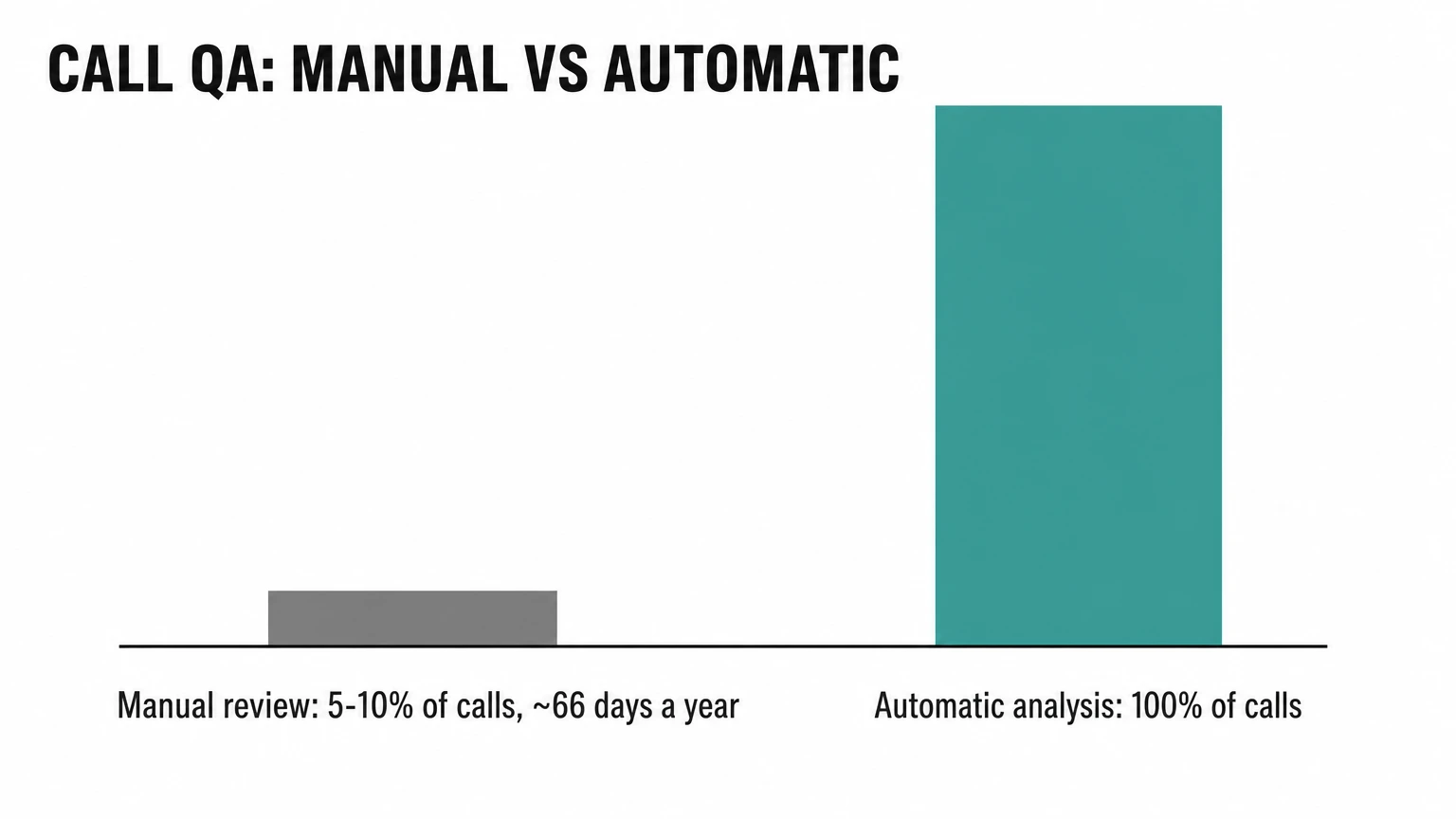
Your sales lead can realistically listen to 5–10% of the team’s calls. Doing it properly, with notes and full attention, costs about two hours a day — roughly 66 working days a year. And it still misses most of what happened on the phone. This is a guide to closing that gap without hiring a QA department.
The problem: you only ever hear a fraction
Every sales team has the same quiet leak. Deals stall on calls nobody reviews. A rep skips the discovery step, mishandles a price objection, promises a discount they shouldn’t have — and the manager finds out weeks later, when the pipeline number is already wrong.
The arithmetic is uncomfortable. To review calls seriously, a head of sales spends around two hours a day listening. Over a year that is about 66 working days out of roughly 250 — around 26% of their working time — spent on a sample that still covers only 5–10% of conversations. The other 90% goes unheard. Not because anyone is lazy: because listening to everything by hand is physically impossible.
Why sample-based QA doesn’t work
Reviewing a handful of calls a week feels like control. It isn’t. Three things break it:
- It’s subjective. Two reviewers score the same call differently. So does the same reviewer on a Monday versus a Friday. Without a fixed scale, “quality” drifts with mood and memory.
- It doesn’t scale. Add reps and the reviewable share shrinks. The bigger the team — exactly when control matters most — the thinner the sample.
- Problems surface late. You catch the broken objection-handling a month after the deals were lost. By then the pattern is a habit across the team, and the revenue is gone.
Sampling tells you a call can be good. It never tells you whether this week’s calls actually were.
What changes when every call is analyzed automatically
Automatic call analysis flips the default. Instead of choosing which 5% to listen to, you review 100% and choose where to spend your attention.
- Full coverage. Every call is transcribed and scored with no manual run. Nothing depends on who had a spare two hours.
- One scale for everyone. A scorecard is the fixed list of criteria a call is graded on; the same one applies to every rep and every call, so scores stay comparable across the team and across weeks.
- 25 parameters across 8 groups. Greeting and rapport, needs discovery, presentation, objection handling, next-step commitment, compliance, and more — configured to your script, not a generic template.
- Every score comes with its receipt. Each mark points to the exact line in the transcript that earned it, with a timecode. You don’t take the tool’s word for it — you open the quote and replay the moment.
| Manual sample QA | Automatic analysis | |
|---|---|---|
| Coverage | 5–10% of calls | 100% of calls |
| Scale | One reviewer’s judgement | One fixed scorecard for the whole team |
| When you find issues | Weeks later | The same day |
| Cost to review more | More reviewer hours | The same — it’s automatic |
| Evidence behind a score | A note from memory | A quote plus timecode you can replay |
How it looks inside Bitrix24
Analysis is only useful where the work already happens. Aelo, built by Grow2.ai, runs natively inside Bitrix24, so the verdict lands where your managers already are:
- On the deal card. After a call ends, the score, flags, and a next-step suggestion appear on the deal or lead as a structured field supervisors can filter on.
- In a Smart Process. Verdicts feed a Smart Process so you can build quality control as a real pipeline: flagged calls, coaching queues, review status.
- As auto-tasks. Commitments made on the call — “send the proposal Tuesday”, “follow up after the demo” — become tasks in Bitrix24 automatically, so nothing quietly falls through.
Nobody opens a second dashboard. The quality signal is on the same card where the deal is worked. That assumes the CRM itself is in working order — if your Bitrix24 pipeline needs an audit or a rebuild first, that is a CRM implementation job rather than an analytics one, and Auspex, the CRM practice Grow2.ai is part of, handles that side. Bitrix24 also has its own AI on board, CoPilot; where it stops and this starts is laid out in the Aelo vs Bitrix24 comparison.
The economics
You can check this one yourself: the Pro plan is $129 a month, so a year of it is about $1,550. Put that against the value of one deal your team recovers because somebody read the call.
- Start at $0. The free tier analyzes 100 minutes a month, no card required. Enough to run real calls through it and see the verdicts before you decide anything.
- 15 minutes to your first analysis. Connect the portal, point it at your telephony, and the first calls come back scored the same day.
- A paid month costs about a third of a working day of your sales lead’s time. The ROI table on our pricing page puts manual QA at 44 hours a month, roughly $2,200 in loaded cost — against $129 for the Pro plan. Instead of spending 66 days a year listening to a sample, you spend about a third of a day’s salary to have every call reviewed.
- Priced on one axis — analyzed minutes. Public tiers from $59/mo (Starter) through $129, $269, and $559/mo, up to custom Enterprise volume. No per-seat surprises; you pay for minutes analyzed, and a budget limiter warns before you hit your cap.
- 90+ languages, EU primary storage for recordings and transcripts, public DPA. Customer content is stored at rest in the EU (in the database and the audio storage; the search index — numerical vectors, no text — and Cloudflare’s processing state, queues, logs, caches and coordination state, some of which hold transcript and chat text for a few days, are not pinned to the EU), while Cloudflare edge processing may occur outside the EU (edge processing means a request is handled at the Cloudflare location closest to it). The DPA and the sub-processor register — the outside vendors that touch your audio and text — are public.
It connects to Bitrix24 natively, and ingests recordings from Binotel, Ringostat, or any SIP telephony that exposes them. A connector to another CRM is built to order: one working day for the estimate, two to three weeks to deliver.
Who this is not for
Automatic call QA is not for everyone, and it’s worth being honest about it.
- You run very few calls. Under roughly 50 calls a month, a person can genuinely listen to all of them and manual review is cheaper. You don’t need a system for that yet.
- Your sales don’t happen on calls. If deals close in chat, email, or in person and the phone is incidental, call analysis solves a problem you don’t have. (If you do work in chats and messengers too, that’s different — those channels can be analyzed alongside calls.)
If either of those is you, save your money until the call volume grows.
For everyone else, here is one example of what that looks like. An agricultural-equipment distributor we work with routes every sales and parts-desk call through Aelo: as of September 2026, 135,000+ calls processed since March, over 20,000 a month, 32,000+ of them scored end-to-end. They never hired a QA team; they stopped trying to listen by hand and let every call be scored the same way. The full breakdown is in the agricultural distributor case study.
Do the sum for your own team
Two numbers decide this, and both are yours: the hours your sales lead spends listening, and what a recovered deal is worth to you. The pricing page has the ROI table with our side of the arithmetic — 44 hours a month of manual QA against the plan that would replace it. Put your own hourly cost and deal size into it before you talk to anyone about a demo.